Quick Answer: How to Change Evinrude E-TEC Lower Unit Oil
To change the lower unit oil on a 2012 Evinrude E-TEC 115–200 HP, position the outboard vertically and check the existing oil level. Remove the upper lubricant level plug and lower drain/fill plug, then drain and inspect the old oil. Pump approved marine gearcase lubricant slowly through the lower opening until it reaches the upper level opening. Install new plug seals and tighten both plugs to 60–84 in-lb (7–9.5 N·m).
Important: Gearcase capacities range from 31.6 to 38.9 US fluid ounces, depending on the gearcase configuration. Confirm your engine model number before servicing.
Step-by-step gearcase oil change instructions, OEM oil capacities, lubricant specifications, drain plug torque, and troubleshooting for 2012 Evinrude E-TEC 115, 130, 150, 175, and 200 HP outboards.
Changing the lower unit oil on your 2012 Evinrude E-TEC is a straightforward maintenance job, but using the wrong oil, overlooking water contamination, or incorrectly filling the gearcase can result in costly repairs.
One detail makes these engines particularly important to identify correctly: the 2012 Evinrude E-TEC 115–200 HP lineup uses six different gearcase configurations, with oil capacities ranging from 31.6 to 38.9 US fluid ounces.
This guide uses specifications from the 2012 Evinrude factory service manual and explains how to identify your gearcase, select the correct lubricant, change the oil, and recognize signs of internal damage.
2012 Evinrude E-TEC Lower Unit Oil Specifications
| Specification | Factory information |
|---|---|
| Engines covered | 115, 115 H.O., 130, 150, 175, 200 HP |
| Engine family | 60° V4 and V6 E-TEC |
| Standard lubricant | Evinrude/Johnson HPF XR |
| High-performance/commercial lubricant | Evinrude/Johnson HPF Pro |
| Drain/fill plug torque | 60–84 in-lb (7–9.5 N·m) |
| Routine service interval | 300 hours or 3 years for average recreational use |
| Factory gearcase filler | P/N 501882 |
| Filling method | Pump through lower opening until oil reaches upper level opening |
Important: Identify your engine model and installed gearcase before selecting the oil capacity. Different gearcases were supplied with engines of the same horsepower.
How much lower unit oil does a 2012 Evinrude E-TEC take?
| Gearcase | Capacity | Metric capacity |
|---|---|---|
| V4 S2 | 31.6 US fl oz | 935 mL |
| V4 O | 32.8 US fl oz | 970 mL |
| V6 O | 33.1 US fl oz | 980 mL |
| V6 M2, standard rotation | 38.9 US fl oz | 1,150 mL |
| V6 M2, counter rotation | 35.8 US fl oz | 1,060 mL |
| V6 L2 | 32.5 US fl oz | 960 mL |
These capacities come from the 2012 factory service specifications. They’re useful for purchasing the correct quantity of lubricant and checking for abnormal fill conditions.
Always use the specified filling method rather than relying on volume alone. The gearcase must be upright and filled slowly through the lower opening until lubricant reaches the upper level opening.
Which Gearcase Does Your 2012 Evinrude E-TEC Have?
Your engine’s horsepower alone is not enough to determine its gearcase oil capacity.
The factory manual identifies gearcase configurations by complete engine model number. Compare your model identification with the following chart.
| Horsepower | Gearcase | 2012 model numbers |
|---|---|---|
| 115 HP | S2 | E115DPLINE, E115DSLINE |
| 115 HP | V4 O | E115DBXINE, E115DPXIINE, E115DCXINM (counter rotation) |
| 115 H.O. | S2 | E115DHLINA, E115HSLINA |
| 115 H.O. | V4 O | E115DHXINA |
| 130 HP | S2 | E130DPLINA, E130DSLINA |
| 130 HP | V4 O | E130DPXINA, E130DCXINA (counter rotation) |
| 150 HP | V6 O | E150DPLINE, E150DSLINE |
| 150 HP | L2 | E150DHLINE, E150HSLINM |
| 150 HP | M2 | E150DBXINE, E150DPXINE, DE150PXINS, E150DCXINE (counter rotation), DE150CXINS (counter rotation) |
| 175 HP | V6 O | E175DPLINE, E175DSLINE |
| 175 HP | M2 | E175DPXINE, E175DCXINE (counter rotation) |
| 200 HP | V6 O | E200DPLIND, E200DSLIND |
| 200 HP | M2 | E200DPXIND, DE200PXINS, E200DCXIND (counter rotation), DE200CXINS (counter rotation) |
Model and gearcase associations are based on the 2012 Evinrude factory service manual, page 9.
How to identify your engine model
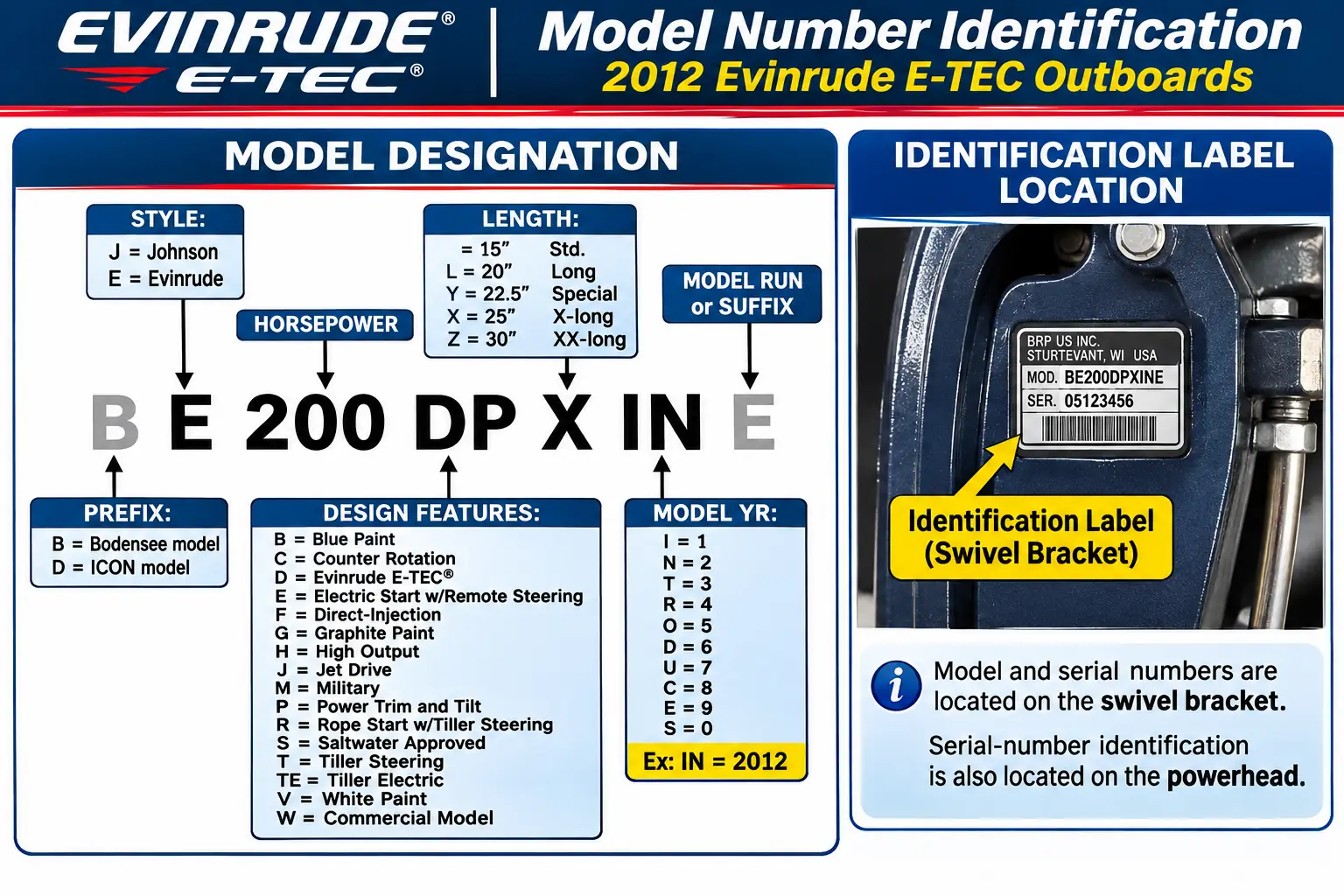
Find the manufacturer’s model and serial-number identification on your outboard’s mounting bracket or identification label.
Compare the complete model number with the table above.
If your engine has a replacement lower unit, the installed gearcase may differ from the original factory configuration. In that situation, verify the actual gearcase before choosing a capacity.
What Gear Oil Should You Use in a 2012 Evinrude E-TEC?
Evinrude specifies dedicated marine gearcase lubricants.
Evinrude/Johnson HPF XR is identified in the factory specifications as the standard gearcase lubricant. HPF Pro is identified in Evinrude guidance for high-performance and commercial operation, and is also referenced in the 2012 maintenance and filling procedures.
These products are intended to protect the internal gears, bearings, and shafts in demanding marine environments.
Do not substitute ordinary automotive gear oil, two-stroke engine oil, or four-stroke engine oil.
Marine gearcases face operating conditions that automotive differentials do not, including the possibility of water entering through damaged seals.
If the original lubricant is unavailable, confirm the currently approved replacement with an authorized parts or service source before filling the gearcase.
Tools and Supplies Required
You will need:
- Correct marine gearcase lubricant in a sufficient quantity.
- Gearcase oil filler pump with a compatible fitting.
- New seals for the upper and lower lubricant plugs.
- Properly fitting drain-plug screwdriver or bit.
- Inch-pound torque wrench.
- Drain pan and shop towels.
- Disposable gloves and eye protection.
- Clear container for inspecting a sample of used oil.
- Equipment to keep the outboard stable and vertical.
The factory manual identifies Gearcase Filler P/N 501882 for the filling procedure.
Verify the correct replacement plug seals for your specific gearcase when ordering parts. This article does not assume that all six configurations use identical sealing hardware.
How to Change the Lower Unit Oil: Step-by-Step
Step 1: Secure the Outboard and Position It Vertically
Park the boat trailer on a stable, level surface and prevent movement.
Lower the outboard into its normal vertical position so the gearcase can drain correctly and be refilled to the proper level.
Turn off the ignition, remove the key, and prevent accidental engine starting. Keep clear of the propeller and moving components.
Safety: Do not work underneath an outboard supported only by its hydraulic tilt system. Be aware that recently operated gearcase lubricant may be hot or pressurized.
Step 2: Locate the Upper Level Plug and Lower Drain/Fill Plug
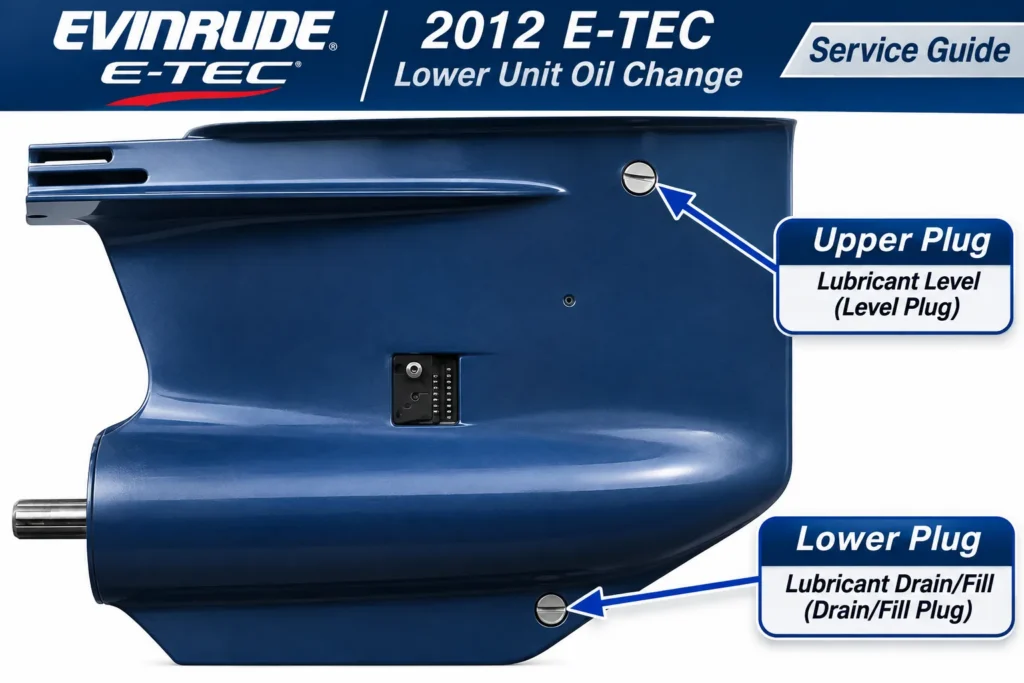
Locate the two lubricant service openings on the gearcase.
The upper plug is used to check the lubricant level. The lower plug is used both to drain the old oil and pump in the replacement lubricant.
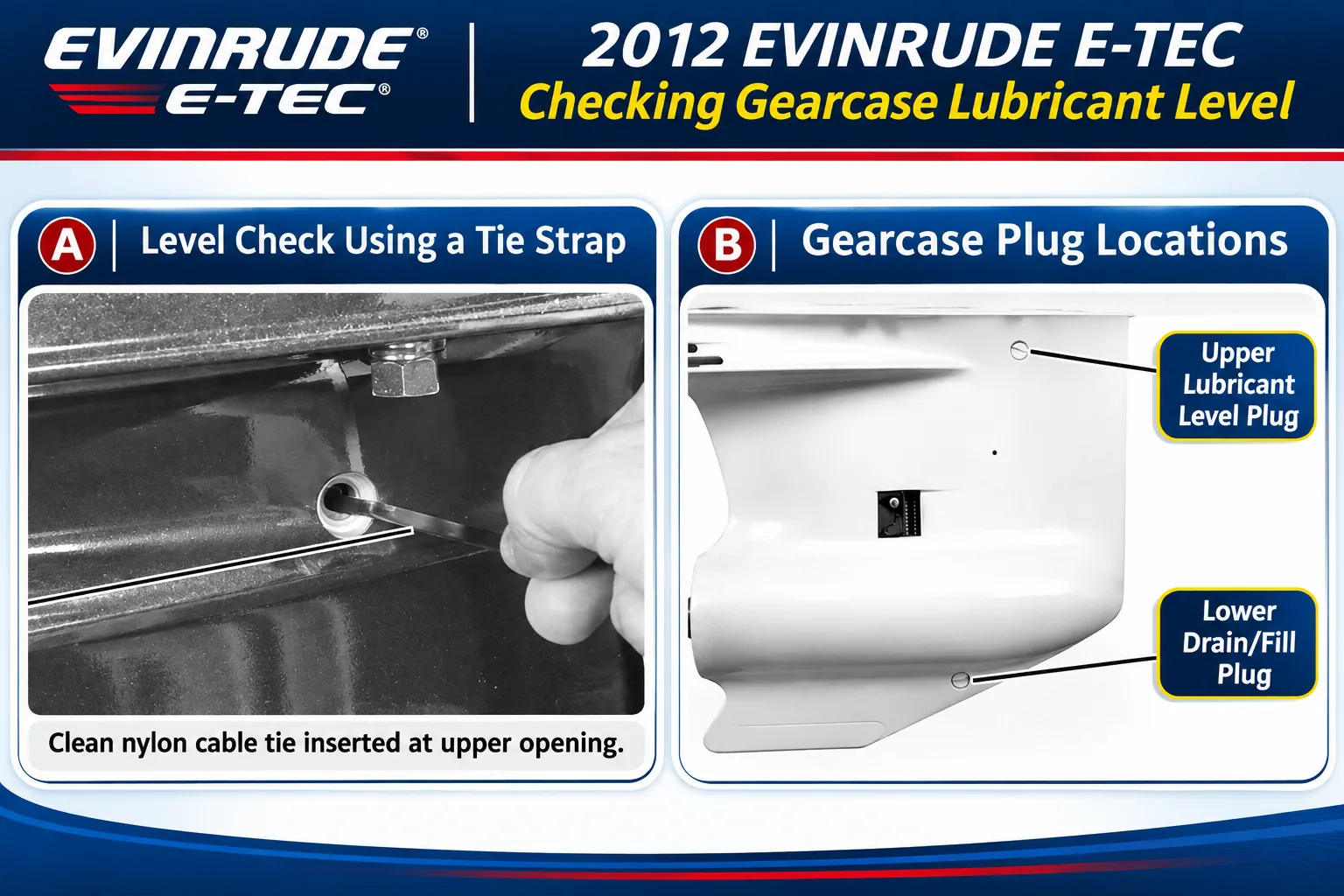
Before removing the lower plug, check the existing lubricant level through the upper opening.
The factory service manual specifically calls for checking the oil level before draining. A clean tie strap can be used as a simple checking aid.
If the oil level is unusually low, do not assume the gearcase simply consumed the lubricant. Lower-unit gear oil is not normally burned during engine operation.
A low level could indicate leakage that requires investigation.
Step 3: Drain the Old Gearcase Lubricant
Position the drain pan beneath the gearcase.
Remove the upper lubricant level plug.
Carefully remove the lower drain/fill plug and allow the lubricant to drain into the pan.
Observe the oil as it begins flowing.
Look for unusual color, suspended particles, separated water, or metal debris.
Inspect the magnetic plugs for particles collected during operation.
Do not immediately discard the old lubricant. Its condition can reveal problems that fresh oil would temporarily conceal.
Step 4: Examine the Used Oil for Water and Metal
A proper gearcase oil change includes an inspection of the old lubricant.
Different appearances can indicate very different conditions.
| What you see | Possible explanation | What to do |
|---|---|---|
| Used oil without obvious contamination | Normal service condition | Continue maintenance |
| Cloudy or milky oil | Water intrusion or temporary aeration | Allow sample to settle |
| Visible separated water | Water entering the gearcase | Investigate seals and leak-test |
| Fine metallic fuzz on magnetic plug | May be normal wear | Evaluate amount and condition |
| Distinct metal chips | Possible internal gear or bearing damage | Stop and inspect |
| Black oil with burned odor | Possible overheating or lubricant breakdown | Investigate before operation |
Is milky gear oil always a bad sign?
Not necessarily.
The 2012 Evinrude service manual explains that normal aeration can temporarily give lubricant a milky appearance.
To distinguish aeration from water contamination, place a sample of drained oil in a clear glass container and let it stand for at least one hour.
Look for separated water or other abnormal contamination.
If water is confirmed, replacing the oil is not enough. The gearcase should be checked for leaks before regular operation resumes.
How much metal on a magnetic drain plug is normal?
Small amounts of fine metallic fuzz can result from normal wear inside the gearcase.
Larger, distinct metal particles are a different concern. They may indicate damage to gears, bearings, or shafts.
Do not assume all metal contamination is harmless. Unusual quantities or large fragments warrant internal inspection.
Step 5: Inspect the Plugs and Prepare New Seals
After draining, examine the upper and lower lubricant plugs.
Inspect the threads, sealing surfaces, and any corrosion around the openings.
Make sure the old seals are removed and that no damaged sealing material remains against the housing.
Use new, correct seals when reinstalling the plugs.
A damaged sealing washer may allow oil to escape or water to enter the gearcase.
Saltwater note: Corrosion around aluminum gearcase threads can make service plugs difficult to remove. Use a correctly fitting tool and avoid excessive force. If a plug is seized or its threads are damaged, professional repair may be safer than risking damage to the housing.
Step 6: Fill the Gearcase From the Bottom
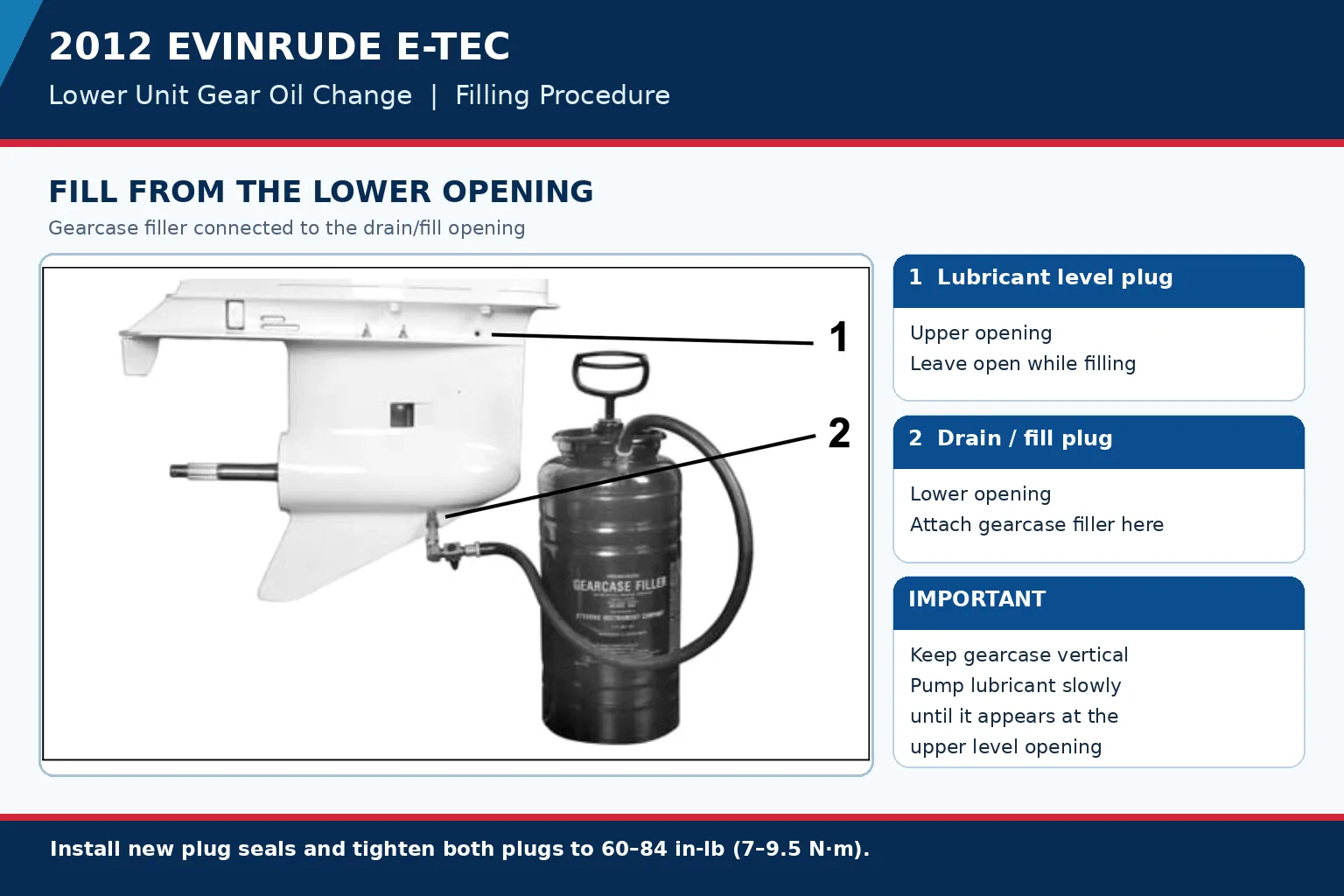
Keep the outboard fully vertical.
Attach the gearcase oil filler pump to the lower drain/fill opening.
Begin pumping the correct gearcase lubricant into the lower opening.
Fill slowly, allowing air to escape through the upper level opening.
Continue until lubricant appears at the upper opening.
Factory service warning: Filling too quickly can trap air pockets inside the gearcase and prevent complete filling.
Do not simply measure out the listed capacity and assume the unit is full. The correct upper-level indication is essential.
For example, an M2 standard-rotation gearcase has a listed capacity of 38.9 US fluid ounces, but the actual service procedure still requires filling through the lower opening until lubricant reaches the upper level hole.
If the amount needed differs substantially from the published capacity, stop and verify the gearcase identification, engine position, and filling procedure.
Step 7: Install New Plug Seals and Torque Both Plugs
When lubricant reaches the upper level opening, clean the upper sealing area.
Install the upper plug with its new seal.
Then disconnect the filler pump and install the lower drain/fill plug with a new seal, minimizing oil loss.
Tighten both plugs to the factory specification:
60–84 in-lb (7–9.5 N·m), equivalent to 5–7 ft-lb.
Use a torque wrench suitable for this low tightening range.
Excessive tightening can damage the aluminum housing threads. Insufficient tightening can compromise the seals.
Clean any spilled lubricant from the gearcase.
Step 8: Check for Leakage and Complete the Service
Inspect both installed plugs and the surrounding gearcase.
Confirm that the plugs are properly seated and that there are no visible leaks.
Check the work area for tools, used seals, and spilled lubricant.
Record the service date, operating hours, lubricant used, and any abnormalities discovered during draining.
If the old oil contained water, significant metal fragments, or signs of overheating, investigate the cause before returning the outboard to service.
A routine oil change is not a substitute for repairing damaged seals or internal gearcase components.
Why Is Water Getting Into My Evinrude Lower Unit?
Water contamination is one of the most important warning signs you can discover during gearcase maintenance.
The gearcase contains rotating shafts, gears, bearings, and several sealing points that must keep lubricant inside and surrounding water outside.
Potential leak locations include:
- Propeller shaft seals.
- Driveshaft seals.
- Shift-shaft sealing components.
- Lubricant plug seals.
- Damaged or corroded housing surfaces.
Fishing line wrapped behind the propeller can also damage the propeller shaft seals and create a path for water intrusion.
If you discover water, a gearcase pressure and vacuum test can help locate a leak.
The 2012 Evinrude factory service manual includes a dedicated gearcase leak-testing procedure. This is a separate diagnostic operation from the basic oil change.
When to stop: If you find free water in the lubricant, repeated water contamination, large metal fragments, or damaged gearcase threads, do not continue normal boating until the cause has been evaluated.
Saltwater Service: What to Inspect Beyond the Oil
Saltwater outboards deserve extra attention around the gearcase, particularly when maintenance has been delayed.
During an oil change, examine the visible condition of the housing, service plugs, and propeller shaft area.
Look for corrosion around the plug heads, damaged sealing surfaces, missing paint, and evidence of leakage.
Inspect the propeller shaft area for fishing line and seal damage. Also check the condition of the gearcase’s corrosion-protection anodes.
A useful maintenance habit is to examine the gearcase oil before long-term storage, particularly following a season of frequent saltwater operation.
If water is present and the outboard sits unused, internal metal components may be exposed to corrosion.
The 2012 Evinrude maintenance schedule specifically recommends more frequent inspection and maintenance for saltwater, polluted-water, heavy-duty, and commercial operation.
How Often Should You Change Evinrude E-TEC Lower Unit Oil?
For the 2012 engines covered here, Evinrude specifies replacement of gearcase lubricant every 300 hours or three years under average recreational operating conditions.
Whichever limit is reached first determines the scheduled service point.
However, that is not a reason to ignore the condition of the gearcase between services.
Boats operated commercially, for extended periods, or in saltwater and polluted environments require more frequent attention.
An owner who discovers water contamination or abnormal oil loss should investigate immediately rather than waiting for the next scheduled oil change.
Common Mistakes That Can Damage an Outboard Gearcase
1. Using automotive gear oil
Use marine gearcase lubricant approved for the engine. Ordinary automotive oil is not a substitute for the specified product.
2. Filling from the upper opening
The gearcase must be filled from the lower drain/fill opening so air can escape as lubricant rises.
3. Filling too quickly
Air pockets can prevent the gearcase from reaching its proper lubricant level.
4. Reusing damaged seals
The upper and lower lubricant plugs must seal correctly to prevent leaks and water intrusion.
5. Overtightening plugs
The correct factory tightening range is 60–84 in-lb, not an arbitrary amount of force.
6. Ignoring contaminated lubricant
Water, large metal fragments, or burnt lubricant may indicate a repair issue that fresh oil cannot solve.
7. Assuming all horsepower ratings use one capacity
A 2012 E-TEC 150 may have a V6 O, M2, or L2 gearcase. Verify the actual configuration before selecting a lubricant quantity.
Frequently Asked Questions
How much lower unit oil does a 2012 Evinrude E-TEC 115 take?
The S2 gearcase holds 31.6 US fluid ounces (935 mL). The V4 O gearcase holds 32.8 US fluid ounces (970 mL). Verify which gearcase is installed on your engine.
How much gear oil does a 2012 Evinrude E-TEC 150 take?
The V6 O gearcase holds 33.1 US fluid ounces, the standard-rotation M2 holds 38.9, the counter-rotation M2 holds 35.8, and the L2 holds 32.5. Confirm your exact engine model.
What is the Evinrude lower unit drain plug torque?
For the 2012 E-TEC 115–200 HP models covered by this guide, the factory specification is 60–84 inch-pounds (7–9.5 N·m).
Should I use HPF XR or HPF Pro gearcase oil?
HPF XR is listed as the standard lubricant in the factory specifications. HPF Pro is identified in Evinrude guidance for high-performance and commercial applications and appears in the 2012 maintenance procedure. Use the manufacturer-approved product for your particular application.
Why is my lower unit oil milky?
Milky lubricant may indicate water intrusion or aeration. The factory manual recommends letting a sample settle for at least one hour to help identify water contamination.
Do I need to remove the lower unit to change the gear oil?
No. Routine lubricant replacement is completed through the external level and drain/fill openings without removing the gearcase.
Can I keep using my outboard if the gear oil has water in it?
Continued operation with contaminated lubricant can damage internal components. Have the source of water intrusion investigated and repaired before resuming normal operation.
Can I change lower unit oil while the boat is in the water?
For this procedure, the outboard must be held upright with both service openings safely accessible and used lubricant contained. Performing the service with the boat secured on a suitable trailer or service stand provides a controlled environment and helps prevent lubricant from entering the water.
Final Checklist: Before You Return to the Water
-
Correct gearcase identified by model number.
-
Manufacturer-approved lubricant used.
-
Old lubricant inspected for water and metal.
-
Gearcase filled slowly through lower opening.
-
Lubricant reached upper level opening.
-
Both plugs installed with new seals.
-
Both plugs torqued to 60–84 in-lb.
-
Gearcase inspected for visible leakage.
-
Any contamination or abnormal wear investigated.
-
Used lubricant collected for proper recycling or disposal.
Final Thoughts
A lower unit oil change is relatively inexpensive maintenance compared with repairing a damaged outboard gearcase.
For a 2012 Evinrude E-TEC 115–200 HP, the key is identifying the correct gearcase, using approved lubricant, filling it properly, and paying close attention to the condition of the old oil.
A few extra minutes inspecting the lubricant can reveal water intrusion, abnormal gear wear, or other developing problems before they lead to an expensive failure on the water.
If the lubricant is contaminated, the gearcase leaks, or the drain plug threads are damaged, have the problem diagnosed before returning the boat to service.
Technical Reference and Scope
Primary reference: 2012 Evinrude E-TEC 115–200 HP Factory Service Manual, covering the 105.4 cubic inch V4 and 158.2 cubic inch V6 engine families.
Relevant manual sections:
- Page 9: Models covered and gearcase configurations.
- Page 11: Service specifications, oil capacities, and gearcase types.
- Page 14: Inspection and maintenance schedule.
- Pages 36–37: Gearcase lubricant draining, inspection, filling, and drain plug torque.
Additional technical guidance: Evinrude/Johnson operator and service literature concerning HPF XR and HPF Pro marine gearcase lubricants.
This article is an independently organized maintenance reference based on published factory procedures. It is not a substitute for confirming the exact engine configuration, current approved parts and lubricants, and applicable service instructions. It is not affiliated with or endorsed by Evinrude or BRP.